
Decision guide
Basement ADU or Traditional Finished Basement?
Both add living space. One stays part of your household, the other is designed and approved as a separate home. Here's how to choose.
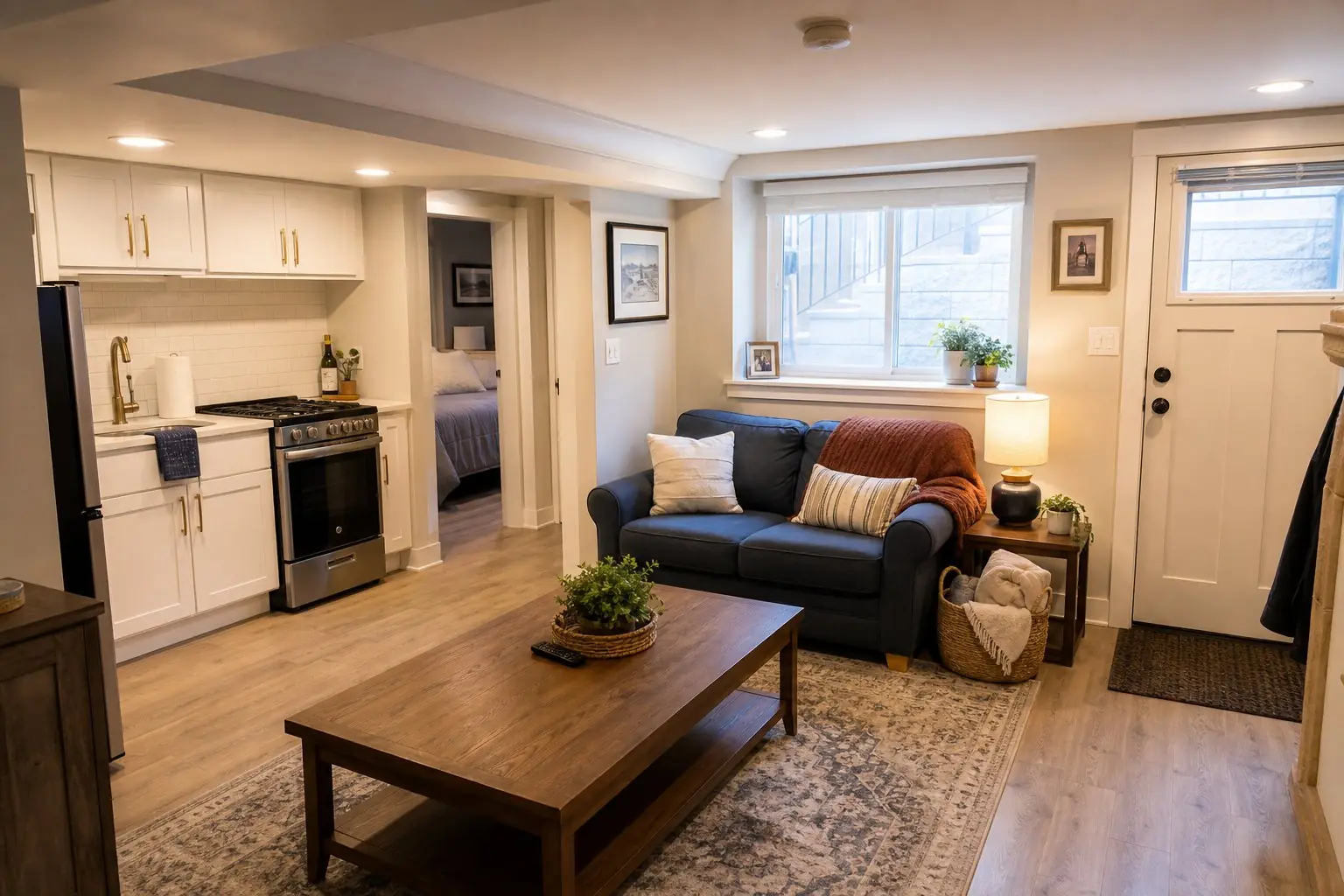
The core difference
Traditional finished basement
- More living space for your household
- Bedrooms, bathroom, family room, bar, office
- Permitted as a basement finish
- Open to the rest of the house
Internal ADU
- A separate dwelling unit inside the home
- Its own living, sleeping, cooking and bathroom spaces
- Separate city approval, often with owner occupancy and parking rules
- Usually its own entrance
In between sits the in-law or guest suite: private space for someone in your household, often with a bathroom and sometimes a kitchenette, that isn't set up as a separate unit. See basement apartments and ADUs.
Questions that decide it
- Who will live there? Your kids and guests, a parent who's part of the household, or a separate household?
- For how long? A few years for a parent or adult child, or indefinitely?
- Does your city and lot allow an ADU? Many cities set lot-size minimums, mapped exclusions or plat-date rules.
- Can you meet the requirements? Owner occupancy, an extra parking space, an entrance location, a license or registration.
- Do you want the space back later? A family basement stays flexible; an ADU is designed for separation.
What Utah law and cities require
Utah Code 10-21-303 makes one internal ADU a permitted use in residential zones for an owner-occupied, detached single-family home, while letting cities require things like an extra parking space, a rental license, owner occupancy and a lot over 6,000 sq ft, and exclude some areas. Cities add details:
- Syracuse: ADUs in the A-1, R-1, R-2, R-3 and RPC zones, owner occupancy with a recorded deed restriction, an extra non-tandem parking space, entrance and size limits, and a minor conditional use permit. See Syracuse.
- Kaysville: no internal ADU on lots of 6,000 sq ft or less, an extra paved non-tandem space, a rental permit for non-family occupants and no stays under 30 days. See Kaysville.
- Farmington: no internal ADU on lots under 6,000 sq ft, the unit no larger than the original home, owner occupancy and Planning Department review. See Farmington.
Design differences
- Entrance: ADUs usually need their own, often via a walkout or exterior stair. See walkout basements.
- Kitchen: an ADU needs one. A family basement may have a wet bar or kitchenette, which some cities still flag.
- Sound and separation: more important for a separate household. See soundproofing.
- Utilities: some cities prohibit separate meters, others allow them.
- Egress: every bedroom needs it either way.
A flexible middle path
If your city and lot allow ADUs but you're not sure you want one, consider a layout that works as family space now and could convert later: a bathroom and kitchenette location near the plumbing, a potential entrance location, bedrooms with egress, and parking that could accommodate an extra space. Confirm with your city what a future conversion would require.
Cost and timing differences
An ADU usually involves more than a finished basement: a full kitchen, a separate entrance, more sound separation, and a separate city application with its own fee and review time. Syracuse, for example, lists a $100 conditional use permit fee plus noticing, and its fee schedule lists impact fees for accessory dwelling units, while Kaysville's business license schedule lists a $65 internal ADU license. The itemized estimate from a walkthrough shows the construction difference for your house.
What we don't promise
We don't make rental income claims or assume a property can hold a legal unit. Those questions get answered for your house during planning and city review.
Common questions
What's the difference between a finished basement and a basement ADU?
A finished basement is more living space for your household. An internal ADU is a separate dwelling unit inside the home with its own living, sleeping, cooking and bathroom facilities, and cities approve it through a separate process with requirements like owner occupancy and parking.
Can I build a basement that could become an ADU later?
Often, if your city and lot allow ADUs. Planning the entrance, egress, kitchen and bathroom locations and parking from the start makes a later conversion simpler. Confirm your city's rules before designing around it.
Does a basement kitchen make it an ADU?
Not automatically, but cities pay attention to kitchens. Farmington's ADU checklist, for example, describes an internal ADU as having a separate full kitchen and full bathroom. If a suite might ever become a separate unit, ask your city early how a kitchen will be treated.
Is an ADU more expensive to build than a finished basement?
Usually, because it needs a full kitchen, its own entrance and more separation, plus a separate approval. The itemized estimate for your basement will show the difference.
Can a family member live in an ADU?
Yes. Many cities' rules focus on the owner living on the property, not on who occupies the unit. Kaysville, for example, requires a rental permit when the unit is occupied by someone other than a related family member.
Choose the version that fits your household
Free walkthrough covering entrance, egress, kitchen and parking options.