
Apartments, ADUs and in-law suites
Basement Apartments, ADUs and In-Law Suites
Room for a parent, an adult child or long-term guests, and sometimes a legal separate unit. Plan the rules in from the start.
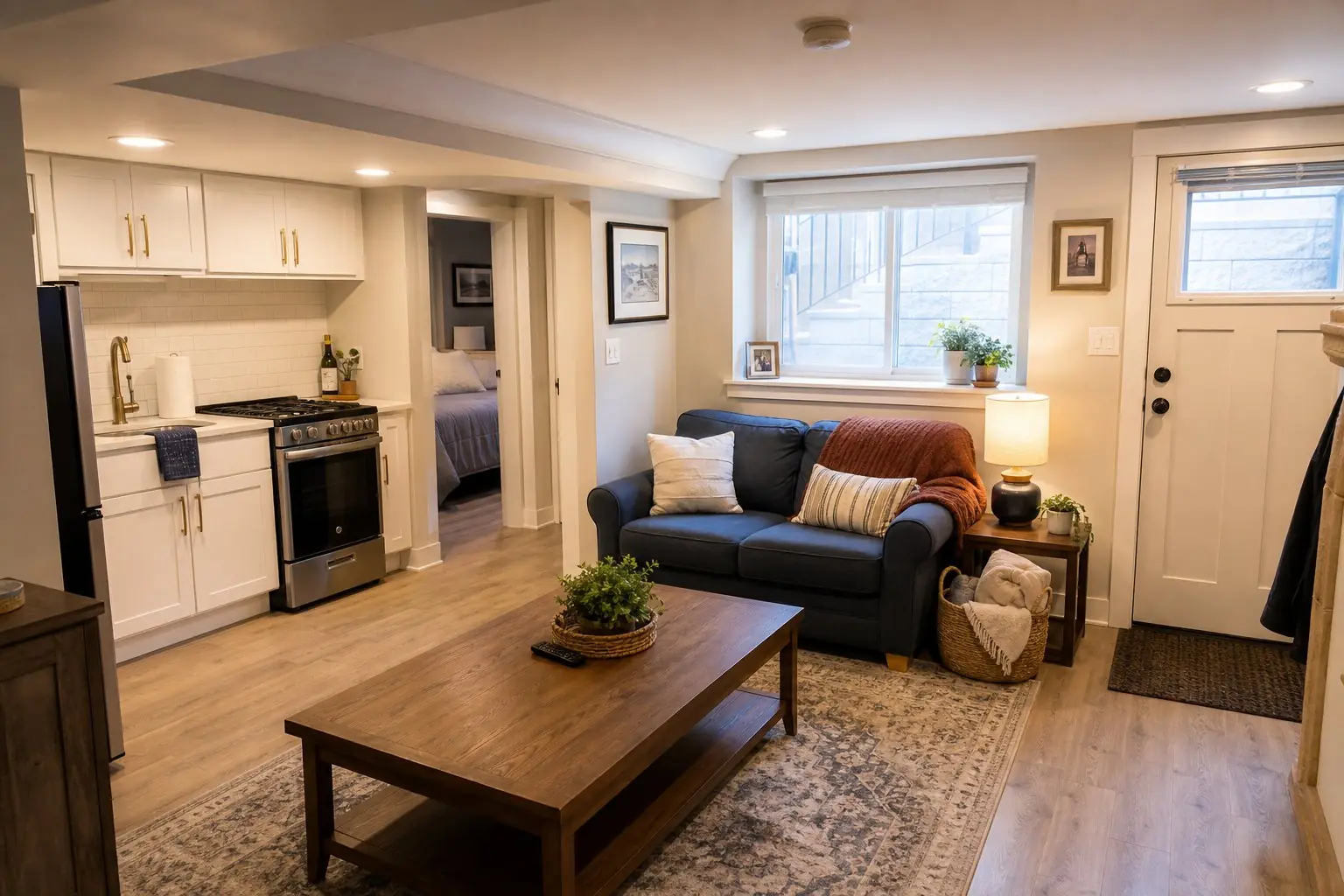
Three different projects with similar names
"Basement apartment" gets used for very different things. Getting clear on which one you want decides how it's designed and permitted:
- Guest suiteA bedroom with a nearby bathroom for visitors. Part of the house, permitted like any basement finish.
- In-law suitePrivate space for a family member who lives with you: bedroom, bathroom, sitting area, sometimes a kitchenette. Usually still part of the main dwelling.
- Internal ADUA separate dwelling unit inside the house with its own living, sleeping, cooking and bathroom facilities. Has its own approval process in most cities.
The line between an in-law suite and an ADU is often the kitchen. Farmington's ADU checklist, for example, describes an internal ADU as having a separate full kitchen and full bathroom. Ask your city early which side of that line your plan falls on.
What Utah law says about internal ADUs
Utah Code 10-21-303 (renumbered from 10-9a-530 in November 2025) makes an internal accessory dwelling unit a permitted use in areas zoned primarily for residential use, for one unit within an owner-occupied, detached single-family home. Cities can't limit the unit's size relative to the house, but the law does let them, among other things:
- require one additional on-site parking space (not where city code already requires four off-street spaces);
- bar units on lots of 6,000 sq ft or less;
- require a permit or license to rent the unit;
- prohibit a separate utility meter;
- require the unit not change the home's appearance as a single-family dwelling;
- prohibit rentals shorter than 30 days, and exclude certain zones within limits.
The unit must also meet building, health and fire codes. Utah's statewide code amendments specifically address accessory dwelling units in existing basements in the emergency escape rules, so egress gets checked as part of approval.
City rules in northern Davis County
Cities fill in the details, and they differ. A few examples, as each city's code or guidance currently reads:
Syracuse
- ADUs allowed in the A-1, R-1, R-2, R-3 and RPC zones, with owner occupancy and a deed restriction recorded before the building permit.
- One additional off-street parking space for an internal or one-bedroom unit, not tandem.
- No new street-facing entrance unless at least 20 feet behind the front of the house.
- A basement unit limited to 50% of the home's gross square footage, no separate utility connections, no nightly or weekly rentals, and a minor conditional use permit. State law makes internal ADUs a permitted use and bars size limits tied to the house, so some of these provisions may not apply to internal units; confirm with the city.
Kaysville and Farmington
- Kaysville: no internal ADU on lots of 6,000 sq ft or less, one extra paved non-tandem parking space, no separate meters, a rental permit when the occupant isn't a family member, and no stays under 30 days.
- Farmington: no internal ADU on lots under 6,000 sq ft, one extra off-street stall, the unit no larger than the original home, owner occupancy of either unit, and review by the Planning Department.
Some city codes were written before Utah's November 2025 changes and may be updated, so treat these as a starting point and confirm with the city. Each city page has more. Requirements depend on the property and proposed use.
Designing a basement that could be a separate unit
- Entrance. A side or rear door, often with a walkout or exterior stair, so the unit doesn't depend on the main house.
- Egress for every bedroom, planned as you would for any basement bedroom. See egress windows.
- Kitchen and bathroom placement near the plumbing rough-in. See wet bars and kitchenettes.
- Sound and separation between the unit and the main floor.
- Parking on the lot for the extra space your city may require.
- Future flexibility. A suite for a parent today can be laid out to meet ADU requirements later, if the city allows it.
What we don't promise
We don't make rental-income claims, and we don't assume a property can hold a legal unit. Zoning, lot, parking and code questions get answered for your specific house during planning and city review.
How it works
A screened local basement contractor contacts you within 24 to 48 hours for a free walkthrough, looks at entrance, egress, plumbing and parking options, and provides a layout sketch, written scope and itemized estimate. You'll know which version of the project fits your house before deciding.
Common questions
Can every Utah home have a basement apartment?
No. Utah law makes one internal accessory dwelling unit a permitted use in residential zones for an owner-occupied, detached single-family home, but cities can still apply certain limits, such as requiring an extra parking space, a rental license, owner occupancy, or excluding some areas. Whether a specific house qualifies depends on the city and the property.
What's the difference between an in-law suite and an ADU?
An in-law or guest suite is living space for people who are part of the household, often with a bedroom, bathroom and sometimes a kitchenette, and is typically permitted as part of the house. An ADU is a separate dwelling unit with its own living, sleeping, cooking and bathroom facilities, and cities process it differently. Syracuse, for example, requires a minor conditional use permit for an ADU.
Do I have to live in the house to have a basement ADU?
In many Utah cities, yes. Syracuse's code, for example, requires the owner to live in either the main home or the ADU and requires a deed restriction recorded before the building permit is issued.
Can I use a basement ADU as a short-term rental?
Utah law allows cities to prohibit internal ADU rentals under 30 days. Kaysville bans stays under 30 days, Farmington's checklist requires occupancy of 30 days or more, and Syracuse prohibits nightly or weekly rentals. Check your city's rules before planning around any rental use.
Will a basement apartment pay for itself?
We don't make rental income claims. Whether a unit is allowed, what it costs to build to code, and what it could rent for all depend on the property and the market. Treat any rental plan as something to verify independently.
Plan space for the people who'll live there
Free walkthrough covering entrance, egress, kitchen and parking options.